
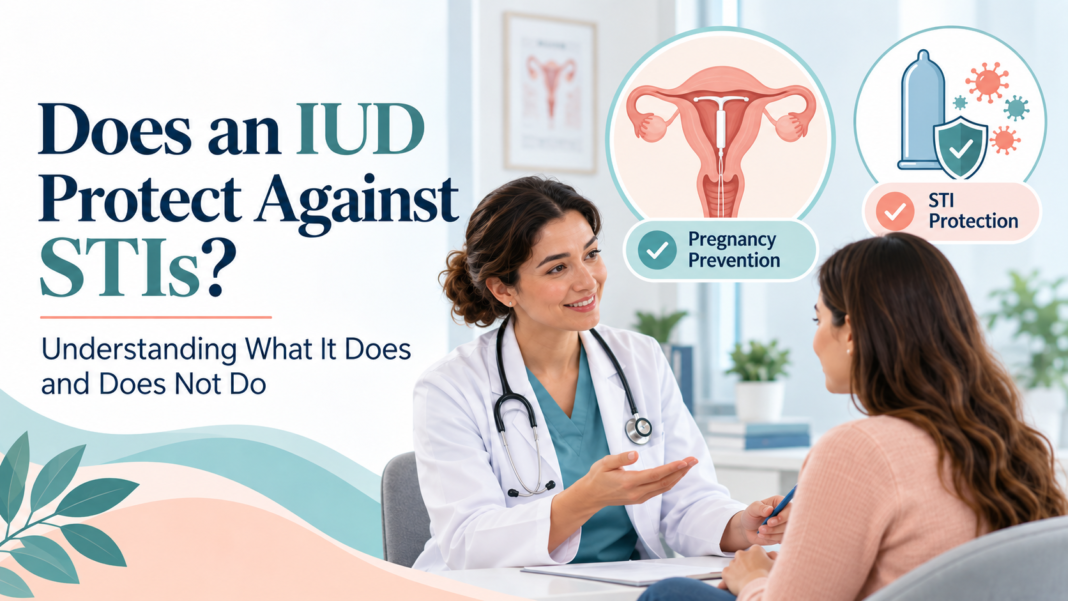

No. An IUD does not protect against sexually transmitted infections, including HIV. This is worth stating plainly and early, because the two things an IUD is good at, preventing pregnancy and having nothing to do day to day, can create the impression that it’s covering more ground than it actually is. It isn’t. An IUD and STI protection are two separate jobs, and only one of them is what the device is built for.
The rest of this comes down to understanding why that’s true, what it means for how you protect yourself, and a couple of related points worth knowing if you’re using or considering an IUD.
Why an IUD Doesn’t Protect Against STIs
The short version: an IUD works locally, inside the uterus, to prevent pregnancy specifically, and its mechanism has nothing to do with blocking the transmission of infections during sex.
Copper IUD create an environment inside the uterus that’s inflammatory to sperm, interfering with sperm movement and function so fertilisation doesn’t happen. Hormonal IUDs work primarily by thickening cervical mucus, which makes it harder for sperm to travel through the cervix, and by thinning the uterine lining. Neither mechanism creates any kind of barrier at the point of sexual contact, which is where STI transmission actually happens, through contact with infected genital skin, mucous membranes, or bodily fluids during vaginal, anal, or oral sex.
A condom works completely differently. It’s a physical barrier that sits between partners during sex and blocks the exchange of the fluids and skin-to-skin contact that transmit infections. That’s a different job in a different place, and it’s why condoms remain the primary tool for STI prevention regardless of what other contraception you’re using.
This is true for essentially every form of hormonal or long-acting contraception, not just IUDs. The pill, the patch, the implant, and the IUD are all built to prevent pregnancy. None of them are built to prevent infection.
What “Dual Protection” Actually Means
You’ll sometimes see the term dual protection used in this context, and it’s a genuinely useful concept once it’s explained properly, rather than just “use a condom too.”
Dual protection means deliberately using two methods together that cover the two separate risks: an IUD (or another highly effective contraceptive) to prevent pregnancy, and condoms to reduce the risk of STI transmission. The IUD doesn’t need the condom to work for its own purpose, it’s already highly effective at preventing pregnancy on its own. The condom isn’t there to boost contraceptive effectiveness. It’s there to cover the risk the IUD was never designed to address.
This matters especially if you or your partner are not in a mutually monogamous relationship where both of you have tested negative for STIs, or if either of you is not certain of the other’s STI status. In those situations, condom use alongside an IUD isn’t an extra precaution. It’s addressing a real and separate risk.
One Thing Worth Knowing: STI Status and IUD Insertion
There’s a specific, clinically relevant point that doesn’t come up in most general explanations of this topic. If you have an active, untreated chlamydia or gonorrhea infection at the time of IUD insertion, there is an increased risk of pelvic inflammatory disease (PID) associated with the insertion procedure itself. This is why screening for these infections is a standard part of the process before or at the time of placement in many clinical settings, particularly for patients with risk factors for STIs.
This isn’t a reason to avoid an IUD. It’s a reason why your gynaecologist may ask about your sexual history and STI testing status as part of the pre-insertion conversation, and why it’s worth being upfront about it rather than treating the question as unrelated to the procedure. If you have any reason to think you might have an active infection, mention it before insertion rather than after.
What an IUD Is Actually Very Good At
It’s worth being clear about the other side of this, since “doesn’t protect against STIs” can read as more of a limitation than it should. Within its actual job, preventing pregnancy, an IUD is one of the most effective methods available, with typical-use effectiveness over 99%, and it requires no daily action once it’s placed. That’s a real strength. It just isn’t the same job as STI prevention, and treating the two as the same thing is where the confusion usually starts.
Getting Tested, Regardless of Your Contraceptive Method
Because IUDs and other highly effective contraceptives don’t provide any visible sign of STI status, and many STIs don’t cause noticeable symptoms, regular STI testing is worth doing based on your actual sexual activity and risk factors, not based on which contraceptive method you’re using. Using an IUD doesn’t reduce your need for testing, and it doesn’t reduce your STI risk in any way. It’s a separate conversation to have with your healthcare provider from the contraceptive conversation, even though they often happen in the same appointment.
Frequently Asked Questions
If I have an IUD, do I still need to use condoms?
For STI protection, yes, if there’s any risk of exposure. The IUD is highly effective at preventing pregnancy on its own, but it provides no protection against STIs. Condoms are the recommended method for reducing that risk, used alongside the IUD.
Can I get an STI even if I have an IUD in place?
Yes. An IUD has no effect on STI transmission risk in either direction. Having an IUD doesn’t make you more or less likely to contract an STI compared to not having one.
Does having an STI affect whether I can get an IUD?
An active, untreated chlamydia or gonorrhea infection at the time of insertion is associated with an increased risk of pelvic inflammatory disease from the procedure, which is why screening is commonly part of the pre-insertion process. This is generally addressed by treating the infection first, not by ruling out an IUD altogether. Discuss your specific situation with your gynaecologist.
Do hormonal IUDs offer any STI protection that copper IUDs don’t?
No. Neither hormonal nor copper IUDs offer any STI protection. Both work through mechanisms specific to preventing pregnancy inside the uterus, not through anything that affects transmission during sexual contact.
If my partner and I have both tested negative for STIs, do we still need condoms with an IUD?
That depends on your specific circumstances, including whether you’re both certain of ongoing mutual monogamy and testing status. This is a personal risk conversation worth having directly with your healthcare provider, since it depends on factors beyond the contraceptive method itself.
SMB Corporation manufactures copper and copper-silver IUDs used by gynaecologists and reproductive health programmes in 148+ countries. Explore SMB’s IUD range to learn more about device specifications and sizing options.