
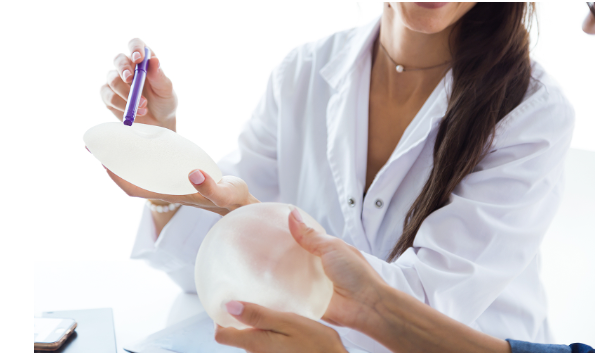

The amount of natural breast tissue a patient has can shape almost every decision in surgical planning. People who are very slim, have a naturally small chest or have lost volume after pregnancy or weight loss may have less tissue to cover and support an implant. That said, for these patients, breast augmentation involves extra considerations to reduce the chance of visible edges, rippling or an unnatural shape. Understanding why coverage matters, and how planning changes as a result, can help you prepare for your consultation.
Why Tissue Coverage Matters
Soft tissue acts as a layer that hides and cushions an implant. When this layer is thin, the implant has less to blend into, and certain issues are more likely to appear over time, including these:
- Rippling or wrinkling of the implant visible through the skin.
- Implant edges that can be felt, especially along the sides or lower pole.
- A rounded upper pole that looks less natural on a slim frame.
- Greater visibility of changes if the implant shifts or the capsule tightens.
Due to these risks, planning for patients with limited tissue tends to focus less on size alone and more on how the result will be covered and supported in the long term.
How Breast Augmentation Planning Differs
With less natural tissue to work with, each stage of planning is adjusted to protect coverage. The differences usually appear in the four areas below.
A More Detailed Assessment
Planning begins with measurements that show how much tissue is available and how much the skin can stretch. A surgeon may look at details like these:
- The thickness of tissue above the breast, often checked with a pinch test.
- Breast width, nipple position and the distance from the nipple to the fold.
- Skin elasticity, stretch marks and any changes after breastfeeding.
- Chest wall shape and any asymmetry.
- Available fat in areas such as the abdomen or thighs.
Using Fat to Add Coverage
If the assessment shows enough donor fat, the surgeon may discuss fat transfer breast augmentation, either on its own or alongside an implant. Fat is taken through liposuction, processed and injected into the breasts, and for patients with limited tissue it may be considered for purposes such as these:
- Adding a layer of fat over an implant to soften its edges, sometimes called a hybrid approach.
- Achieving a modest increase in size without an implant.
- Correcting minor asymmetry between the breasts.
Very slim patients may not have enough fat to harvest, and not all transferred fat survives, so more than one session may be needed.
Where the Implant Is Placed
When an implant is part of the plan, its position in relation to the chest muscle becomes a central decision. Surgeons commonly weigh options like these:
- Placing the implant partly or fully under the chest muscle to add another layer of coverage.
- Dual-plane techniques, which combine muscle cover in the upper area with tissue cover lower down.
- Placement above the muscle, which is generally used with more caution when tissue is thin.
- How placement affects implant movement when the chest muscles are used.
Choosing Implant Type and Size
The implant itself also needs to suit the coverage available. Factors usually discussed include the following:
- Silicone gel implants, which tend to show less rippling than saline implants in thin patients.
- Round or anatomical shapes, depending on the desired profile.
- Base width that fits within the natural chest width.
- A moderate volume that the existing skin and tissue can support.
- Implant surface texture, which the surgeon may discuss in relation to long-term safety.
Planning Around Your Own Anatomy
Limited natural breast tissue does not rule out augmentation, but it does change how the procedure is planned, from assessment and fat transfer to implant placement and choice. Discussing your goals with a plastic surgeon, along with the trade-offs between size and long-term appearance, can help you reach a plan that fits your body.
Request a consultation with Shens Clinic to discuss breast augmentation planning for your build.